Christ of the Wheelchair
by Derek Yoder
“Our God is a God who makes friends!” sings Anabaptist musician Bryan Moyer Suderman. I think this means that God meets us in so many ways. The ways must be as numerous as the people of God! For example, we might learn to know God through scripture or creation or art or silence, just to name a few. Of course, Christ’s incarnation is the ultimate example of how God comes to meet us. Truly, “God is love” (1 John 4:8).
I am a pastor to people with intellectual disabilities at Pleasant View in Harrisonburg, Virginia. It is my joy to encounter God among them every day. But at an earlier time in my life, I struggled, saying, “God, how will I find you?” My answer came from one of Jesus’ parables in Matthew’s gospel: “I was a stranger, and you welcomed me” (25:35). It seemed to me that perhaps in extending hospitality, I might meet God.
As I journeyed from a previous job in Illinois, first to Pennsylvania and eventually to Virginia, I tried to learn about welcoming the stranger. Along the way, one friend suggested that I reach out to Pleasant View. “My friends with intellectual disabilities are good at extending hospitality,” she said. “You could learn something from them.” So, for the last ten years, I have received and learned hospitality in this community. Along the way, I was invited to become their pastor. I’m reminded of the beautiful invitation given to Henri Nouwen who, having become weary of the life of an academic, was contacted by a L’Arche community (where people with and without disabilities live life together). “Come waste some time with us,” they said. “We have something to offer you, and we have something to receive from you.”
During that time, I was engaging in seminary studies. As my studies reached their conclusion, I wished to convey gratitude to my community at Pleasant View and express to them that they are equally created in the image of God. Images are important for the way that we understand God. Each person bears the image of God. In our commonality and diversity, we each contribute to how we understand God. Yet it seems to me that persons with disabilities are not frequently regarded as suitable images—icons—for God.
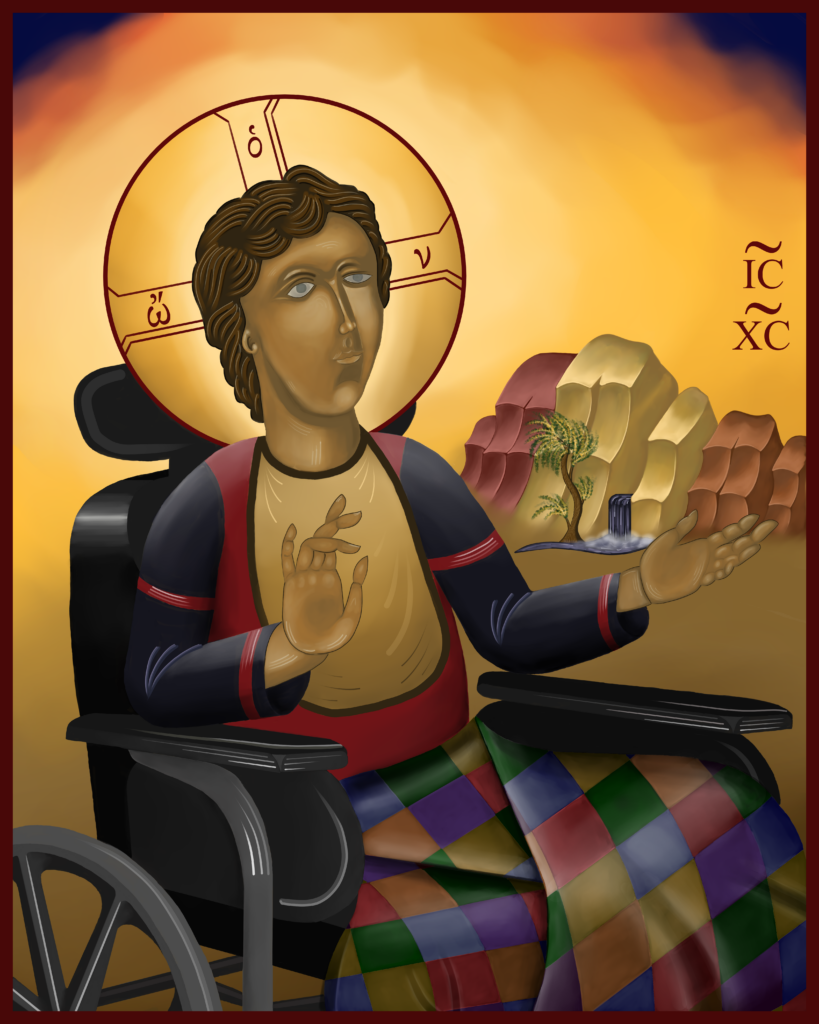
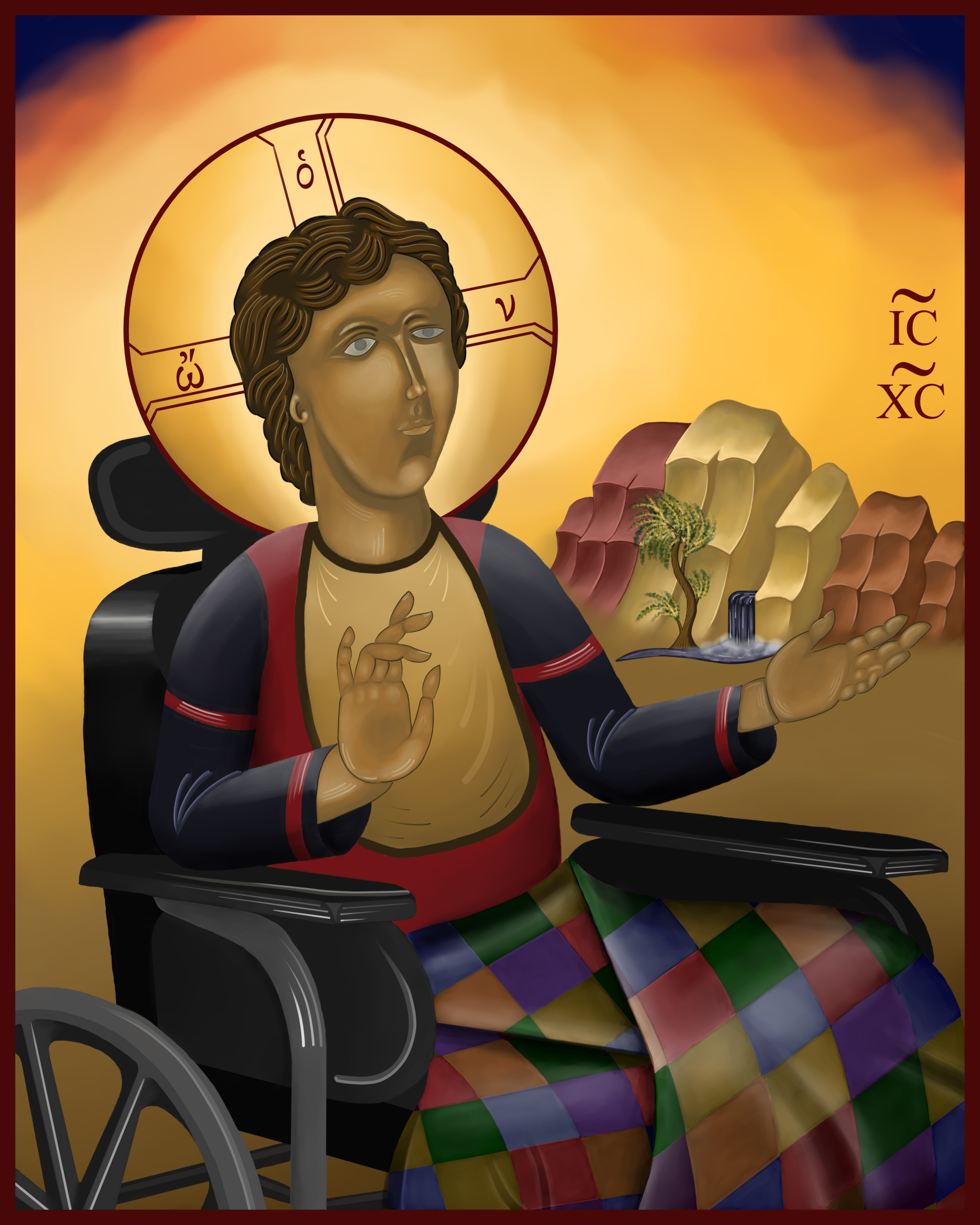
So I created the icon Christ of the Wheelchair. Sometimes, we hear the phrase, “write an icon,” indicating that the icon may be “read” as one reads scripture. I like to say that I ”prayed” the icon. It began as a prayer for my community, that they would know their belovedness and their essential place in the Body of Christ. My prayer quickly became a prayer for myself as well, and then for the Church as a whole: a prayer that all of us would receive welcome and hospitality, that we could each give and receive the gifts that the Holy Spirit bestows, and each of us could be ministers of God’s grace.
As Anabaptists, we do not have a history of engaging with icons. Sometimes we are uncomfortable with these images. As I was offering the prayer of Christ of the Wheelchair, I found it helpful to consider a distinction between veneration and worship. Worship is reserved for God alone; veneration is deep respect. When I encounter the image of God in my community—no matter who bears that image—I venerate that image, and I worship the Creator who breathes life into that image.
In Christ of the Wheelchair, I ponder many mysteries about God, informed by the image of God I see at Pleasant View. I reflect on the divinity and humanity of Jesus. I contemplate relationships and the time that they require. I receive hospitality and blessing. I recall Christ’s baptism and transfiguration, when the voice said, “You are my beloved” (Mark 1:11; 9:7), and I know that we are also beloved of God. I think of Jesus’s cross, how he was excluded from his community, and how persons in my community have faced exclusion as well.
In and through all of this, I am compelled to worship God.
I hope that Christ of the Wheelchair will compel others to worship God, and I welcome discussion and invite others to use the icon. But in any case, my desire for all of us is that we will watch closely for God, who shows up in ways we do not expect. As poet Gerald Manley Hopkins has said, “Christ plays in ten thousand places / Lovely in limbs, and lovely in eyes not his” (in “As Kingfishers Catch Fire, Dragonflies Draw Flame”). Extend hospitality and welcome the stranger, because as we do, we welcome Jesus.

Derek Yoder is pastor at Pleasant View in Harrisonburg, VA, an organization that supports individuals with intellectual disabilities in living out their goals for meaningful work, relationships, and spiritual development. Pleasant View is a conference-endorsed ministry of Virginia Mennonite Conference. Derek worships with Shenandoah Valley Faith & Light and with Community Mennonite Church in Harrisonburg. When not with his community at Pleasant View, he’s probably somewhere with his family, looking for birds. Or drinking coffee. Or both.